back
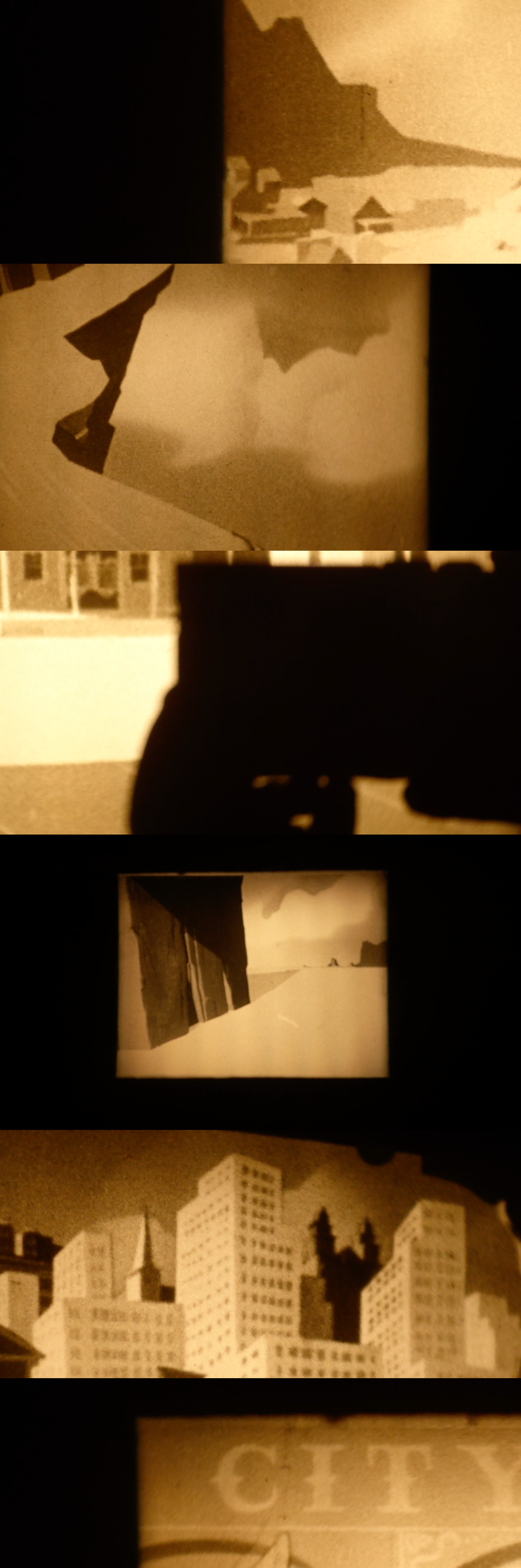
Hannah Frank’s Frame by Frame, published as a developed version of her PhD thesis after her untimely death in 2017, documents her process of painstakingly examining “the individual animation cels from which animated cartoons of the studio era were composed,” as she traces the “technological shifts in animation processes and how these affected what we watch on the screen.” Fundamental to her approach is an absolute foregrounding of the cartoon as produced material; what can be learned, she asks, from viewing these cultural artefacts as being first and foremost a series of singular images which were each created, at one time or another, by someone? Despite the fact that the specifics of background production feature comparatively very little in Franks analysis when pitted against the animated cels, it is through a brief discussion of the relationship between layout artist and background painter that she most pointedly summarises her methodology as a whole. “Consider Chuck Jones’s remarks about the background painter Phil DeGuard,” she writes, “who often worked in conjunction with the layout artist Maurice Noble”:
According to Jones, DeGuard received too much credit for the work he did, work that should have been attributed to Noble instead: DeGuard “bears the same relationship to the layout man [Noble], in preparing a picture, that a contractor does to an architect in constructing a building.” But what would an aesthetic appraisal of a building that attends not to the architect but to the contractor look like? Or what about one that examines each and every brick?
Using a range of digital technologies – “DVDs and YouTube, not to mention QuickTime, Final Cut Pro, and Adobe Photoshop” – Frank scrubs through the material of the finished cartoons, literally viewing them frame by frame. What she is searching for in her examination is “a brick that sticks out—a brick that preserves the traces of the hand that touched it, a brick that bears the signature of an unknown name, a brick that is a self-portrait of an anonymous artist.” The traces of life and work which Frank hopes to find are revealed in moments of accident and incident: blurred inks, smudged paint, fingerprints, dust, dirt. Her analysis in these instances takes on a specifically Marxist materialist bent, emphasising the labour-intensive processes of cartoon production and the ways that these acts of labour interact with developing technologies of capture and display.
She gives us a brief list of avant-garde films in which pre-existing animated material is either referenced or used as a direct source: Stan Brakhage’s Murder Pslam (1980), which uses snippets of a colourised version of the 1931 Warner Bros. cartoon One More Time; Standish Lawler’s rephotography and optical printing experiments Runaway and Roadfilm, both 1970, the source for which was Terrytoons’ The Fox Hunt (1927); Bruce Conner’s Cosmic Ray (1962), wherein classic Mickey Mouse cartoons are intercut with newsreel footage of atomic bombs and collaged clips of female nudes. The “fetishistic attention to detail and repurposing of found fragments” seen in these works and throughout the artistic vein of montage and collage is, in Frank’s eyes, a method of research. “And, in turn,” she writes, “my methodology is a form of montage.” In this, Frank references the poet Susan Howe’s description of Herman Melville and Emily Dickinson’s pre-filmic, literary uses of ‘montage’: “Their writing practice (varied though it was) involved comparing and linking fragments or shots, selecting fragments for scenes, reducing multitudes (chapters or stanzas) and shots (lines and single words) to correlate with one another, constantly interweaving traces of the past to overcome restrictions of temporal framing.” There is a distinct level of care which comes through in Frank’s approach; in her looking at the material basis of these cartoons and engaging with their history, composition, context and mistakes. She does so not out of a destructive drive toward scrutiny, however; this engagement instead comes from a place of genuine curiosity and a belief in the power of images to both conceal and reveal knowledge: “These cartoons are not closed compositions,” she writes. “They show and they hide.”
next